
Know the object
Sustainability & certification
Which marks mean what, which ones Green Star recognises, and which of the products we supply we can put a certificate behind.
Most furniture is sold as "sustainable". Very little of it comes with a document. This page is the difference: every certification shown on this site is a certificate we hold, with the scheme, the level and the number a specifier needs — and nothing is shown once it has expired.
177 of our 714 products carry a current environmental certification today. That number is low because it is honest, and it will climb as the certificates come in from the brands we represent.
What we can evidence today
Each one links to the products it covers.
- GECA — Level A35 products →
- Global GreenTag1 product →
- AFRDI Green Tick — Level A, Level B16 products →
- BIFMA LEVEL — 25 products →
- FEMB level — 296 products →
- GREENGUARD16 products →
- Blue Angel — plastic shell models, visitor chair5 products →
- EU Ecolabel47 products →
- FSC28 products →
- Recycled content2 products →
- EPD — ISO 1402514 products →
- CAM Arredi2 products →
- Other1 product →
- Plastica Seconda Vita1 product →
At company level
These belong to the manufacturer rather than to any one product, so they are shown on the brand and never as a product claim.
- Actiu — FSC, PEFC / Responsible Wood, ISO 14001, B Corp, ISO 9001
- Chair Solutions — ISO 14001, ISO 9001
- CMS Electracom — ISO 14001
- Dauphin — ISO 14001, EMAS
- Ergotron — ISO 14001 Dongguan facility
- Markant — ISO 14001, ISO 9001
- Nardi — ISO 9001
- Siesta — ISO 14001, ISO 14064-1, ISO 9001
- Thinking Works — ISO 14001
- Trendoffice — ISO 14001, EMAS
- Züco — ISO 14001, EMAS
The marks you will meet
Recognised by Green Star
GECA
35 products →Australia's own ecolabel, run to ISO 14024. It looks at the whole life of the product — the materials and where they come from, emissions and chemicals of concern, manufacture, packaging, and what happens at the end — plus the maker's labour practices.
What it does not tell you: It certifies the products named on the licence, not everything the brand makes. Always check the schedule covers the model you are specifying.
Levels — The Furniture, Fittings, Foam & Mattresses standard is GBCA Level A; the lighter Furniture and Fittings standard is Level B.
Global GreenTag
1 product →An Australian scheme that scores a product across its whole life and publishes the result as a rating. Its separate PlatinumHEALTH declaration reports what is in the product and its health impacts.
What it does not tell you: The GreenRate level and the health declaration are different things; a product may hold one and not the other.
Levels — GreenRate Level A, B or C.
AFRDI Green Tick
16 products →Furntech-AFRDI's sustainability certification, assessed against AFRDI Standard 150. It covers the product and the site it is assembled at, and is audited.
What it does not tell you: Easily confused with AFRDI Blue Tick, which is strength and durability and says nothing about the environment. The colour is the whole difference.
Levels — Level A Platinum and Level B Gold are GBCA Level A; Level C Silver is GBCA Level B.
Product marks from overseas
BIFMA LEVEL
5 products →The North American furniture sustainability standard. Uniquely, it assesses three things at once: the product, the factory that makes it, and the company behind the brand.
What it does not tell you: An American standard. Green Star does not recognise it directly, though the underlying evidence often helps.
Levels — LEVEL 1 to LEVEL 4 under the current e3.
FEMB level
96 products →The European equivalent of BIFMA LEVEL, run by the European furniture federation and audited by third parties.
What it does not tell you: European. As with BIFMA, it is evidence rather than a Green Star credit in itself.
Levels — level 1, 2 or 3.

GREENGUARD
16 products →Chemical emissions. The product is tested in a chamber and has to stay under limits for volatile organic compounds, so it does not degrade the air in a closed room. GREENGUARD Gold is the stricter tier, set for schools and healthcare.
What it does not tell you: It is about the air, and nothing else. A GREENGUARD chair can still be made from virgin materials in a factory with no environmental programme. It is a good mark, frequently over-read.
Levels — GREENGUARD, and GREENGUARD Gold.
Blue Angel
5 products →Germany's federal ecolabel, running since 1978. For office furniture it covers materials, emissions, durability and recyclability.
What it does not tell you: Awarded per product, to a German standard. Check it covers the exact model.
Nordic Swan
The official Nordic ecolabel: timber from sustainable forestry, limits on hazardous substances, and climate and energy impact. Every document is reviewed before a product is approved.
What it does not tell you: Scandinavian. Common on the European brands, rare on Australian-made furniture.

Möbelfakta
A Swedish furniture label with three parts — quality, environment, and social responsibility. One of the few that sets requirements for the conditions of the people who make the furniture.
What it does not tell you: Documents are fully reviewed only for a maker's first labelled product.
EU Ecolabel
47 products →The European Union's official ecolabel, covering the product's life cycle against criteria set per product group.
What it does not tell you: Less common on commercial furniture than the national labels above.
Cradle to Cradle
Assesses material health, circularity, clean air and climate, water, and social fairness, and is designed around the product being taken apart and used again.
What it does not tell you: The overall mark is set by the lowest of its categories, so read the category scores, not just the headline.
Levels — Bronze, Silver, Gold, Platinum.
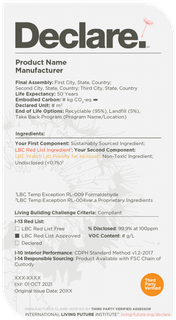
Declare
An ingredients label. The maker declares what is in the product and whether it avoids the Living Building Challenge Red List.
What it does not tell you: A disclosure, not a pass mark: it tells you what is there, and leaves the judgement to you.
Materials and carbon
Chain of custody for the timber: the wood is traceable back to a responsibly managed forest, through every business that handled it.
What it does not tell you: It covers the timber, not the chair. Nothing is said about the foam, the fabric, the steel or the factory.
PEFC / Responsible Wood
The other timber chain-of-custody scheme. Responsible Wood is the Australian member of PEFC, so most locally grown certified timber comes through it.
What it does not tell you: Same as FSC: the timber, not the whole product.
Recycled content
2 products →The share of the product made from recycled material, as documented by the maker.
What it does not tell you: Unless it is third-party verified, this is the manufacturer's own figure. Ask what was measured and how.

An Environmental Product Declaration: a published, verified life-cycle assessment giving the product's carbon footprint and other impacts as numbers.
What it does not tell you: It is data, not a verdict. An EPD does not mean a product performed well — it means the impacts were measured and published. That is what makes it useful for comparing two products honestly.
The company, not the product

ISO 14001
The manufacturer runs an audited environmental management system: it tracks its impacts, sets targets and is checked against them.
What it does not tell you: It is about how the company is run, not about any particular chair. "Made in an ISO 14001 factory" is not a product claim.

EMAS
The EU's eco-management and audit scheme, stricter than ISO 14001 and requiring a published environmental statement.
What it does not tell you: Again, the organisation rather than the product.
ISO 50001
A certified energy management system at the manufacturer.
What it does not tell you: The factory's energy use, not the product.
ISO 14064-1
The company's own greenhouse gas inventory, measured and verified.
What it does not tell you: A corporate footprint. For a product footprint you want an EPD.
B Corp
Certifies the whole business against social and environmental performance, governance and transparency.
What it does not tell you: A company certification. It says nothing specific about the product you are specifying.
Not an environmental mark
AFRDI Blue Tick
Furntech-AFRDI's testing for strength, durability, safety and stability — the mark that tells you a chair will survive commercial use. Blue Tick: Rated Load adds a user weight, such as 135 kg or 160 kg.
What it does not tell you: It is not a sustainability mark, and it is the one most often mistaken for one, because AFRDI runs Green Tick as well. A long-lived chair is a genuinely greener chair, but Blue Tick does not assess that.
Levels — Up to Level 6, severe commercial.
ISO 9001
A certified quality management system: the manufacturer has documented processes and is audited against them.
What it does not tell you: Quality, not environment. Its sister standard ISO 14001 is the environmental one.
How we record it
- A certificate, or nothing
- A mark goes on a product when we hold the certificate, with its number. A brand's marketing page is not evidence, and we do not publish one as though it were.
- Expiry takes it down by itself
- Certificates lapse, usually every two or three years, and a lapsed mark left on a page is a false claim. Each record carries its expiry date, and the site stops showing it the day it passes — no one has to remember.
- The product, or the company — not both at once
- "Made in an ISO 14001 factory" is a fact about the manufacturer, not about the chair. Company certifications appear on the brand; only a product-level environmental certificate puts a product in the certified list.
- Where a range is only part certified, it says so
- Schemes certify models, not ranges. Where a certificate covers one version of a range, the badge names that version rather than implying the rest.
Specifying for Green Star or WELL?
Tell us the products and the submission, and we will get the current certificates from the manufacturer — including the ones we have not published yet.